

How natural gas billing and services work
In Georgia, Atlanta Gas Light and your marketer work together to provide you with natural gas service to your home. Each serves its own unique purpose in providing you with safe and reliable service.
The tariff is our company’s terms of service, schedules of rates and charges, and rules and regulations on file with the Georgia Public Service Commission. For more information, please see the Company’s current Tariff Provisions below.
Collaborating For Reliable Natural Gas
Your natural gas service is a partnership between Atlanta Gas Light and your natural gas marketer.

Atlanta Gas Light
(Base Charge)
Owns and operates the system of pipes and equipment that carry natural gas from its source to your home.
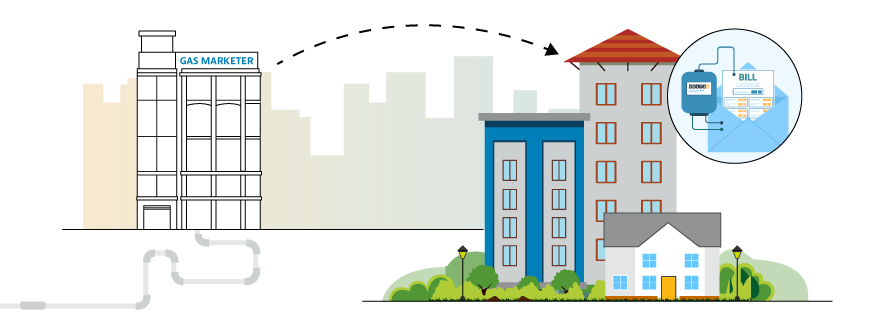
Natural Gas Marketer
(Base Charge)
The marketer purchases the gas commodity itself that is delivered to your home through the AGL system.
What To Know About Choosing A Natural Gas Marketer
In Georgia, customers are required to select a natural gas marketer to receive service. Your natural gas bill will come from your marketer and you will not receive a bill from Atlanta Gas Light.
Your Natural Gas Bill Consists of Three Main Parts

1.
Base Charge
The base charge or the AGL service charge. This is regulated and set by the Public Service Commission.

2.
Gas Charge
This is the cost of the gas used. Natural gas prices are set by the marketers, not the Public Service Commission.

3.
Sales Tax
This is set by the state, county and city where you live.
Who do I contact about my bill?
Regardless of the charge in question, you must contact your marketer first. In the event they cannot answer your question, they will contact AGL directly for resolution.
How Atlanta Gas Light (AGL) Charges For Its Services
Regardless of the marketer chosen, customers will see base charges from Atlanta Gas Light (AGL) on their monthly marketer statements.
What these base charges cover:
Delivery: Moving the gas through the system to your door.
Infrastructure: Maintaining the actual pipelines.
Service: Reading your meter to see how much you used.
What is included in my AGL base charges?
Customer Charge: A flat monthly fee for gas connection to your home or business.
Dedicated Design Day Capacity (DDDC): A charge based upon a customer’s projected usage for the coldest day of the year. (Links to section below)
Meter Reading: The cost to read your gas meter.
Peaking Service: The cost of operating company-owned, above-ground storage facilities. This helps ensure an adequate supply of gas on the coldest day of the year. (Atlanta and Macon areas only).
Franchise Recovery: Reimburses the Atlanta Gas Light for fees paid to local governments for the use of public rights-of-way for natural gas lines and other facilities.
Social Responsibility Cost Rider: Funds gas discounts for low-income seniors.
Environmental Fee: Recovers expenses for the cleanup of old gas plant sites.
System Reinforcement: Covers the cost of strengthening pipelines and improving gas pressure.
ECON-1: Recovers costs associated with natural gas investments directed by the PSC that provide wider public benefit to the communities in which they are located.
DOT Rider: Covers the cost of moving pipes due to road construction or widening by the Georgia Department of Transportation.
What is my DDDC factor?
What it pays for: It covers the cost of having enough pipe capacity to serve you on the coldest day of the year.
Annual update: Every September 1, your DDDC factor is updated and approved by the Georgia Public Service Commission based on your usage from the previous year.
How it’s calculated:
Existing buildings: AGL looks at your past usage patterns or the number of gas appliances and how many gas appliances you have to determine a location’s demand on the system.
New buildings: If there’s no history, AGL estimates based on square footage and equipment and appliance types and quantity.
Why it changes: If you add a gas fireplace or stop using a gas heater, your usage pattern changes, which can shift your DDDC.
Disputes: If your factor seems too high, contact your marketer to review it.
How Are AGL Rate Amounts Determined?
The Georgia Public Service Commission (PSC) regulates AGL’s rates through an annual review called Georgia Rate Adjustment Mechanism (GRAM).
How it works: Once a year, AGL submits its costs— based on historical expenses adjusted for inflation, and forecasted capital expenditures, revenues, labor and benefit costs—to the PSC.
The result: Rates are adjusted up or down to reflect the actual, current cost of providing utility service.
The goal: Pricing that is a transparent and continuous process through GRAM adjusting with real-time changes in factors that influence utility rates.
Basically: Your rates change annually based on a public review of AGL’s real business expenses.
How Natural Gas Marketers Charge For Their Services
Pay by the “Therm”: Marketers charge for the natural gas delivered to your home or business on a per-therm basis. A therm is a standard unit of heat energy.
Extra Fees: Other charges for items like customer service, special programs, or early termination.
Compare Carefully: Because pricing plans and contract terms vary by marketer, customers should review all conditions carefully before enrolling. Written confirmation of selected plans and contract terms is strongly recommended. Some marketers may offer discounted pricing for senior citizens. Customers who believe they may qualify should inquire directly with their chosen marketer.
How Do I Calculate My AGL Base Charges?
DDDC Calculation Example
Your DDDC factor is (found on your bill), the AGL capacity rate is per unit and the billing cycle is days.
The calculation is:
Formula:
DDDC Factor x AGL Rate x Days
Example Calculation:
1.5 x $5.68 x 30 days = $255.60
The DDDC factor is recalculated annually based on your previous winter’s usage.
Use our Base Rate Calculator link below to see how your AGL base charges were calculated.
In red below is an example of base areas to enter at the top of the Base Rate Calculator. You will need to know your DDDC factor, which is printed on your bill. Type in your DDDC factor, answer the Pool Group and Senior Discount choices, and choose the month you would like to view to calculate your Atlanta Gas Light pass-through charge. Use the bottom tab in the calculator to calculate your annual rate.
DDDC Factor: (Enter your DDDC factor 0.? from your bill)
Peaking Pool Group? Yes or No
Senior Discount? Yes or No
Base Charges for the Month of: (Choose month in dropdown)


